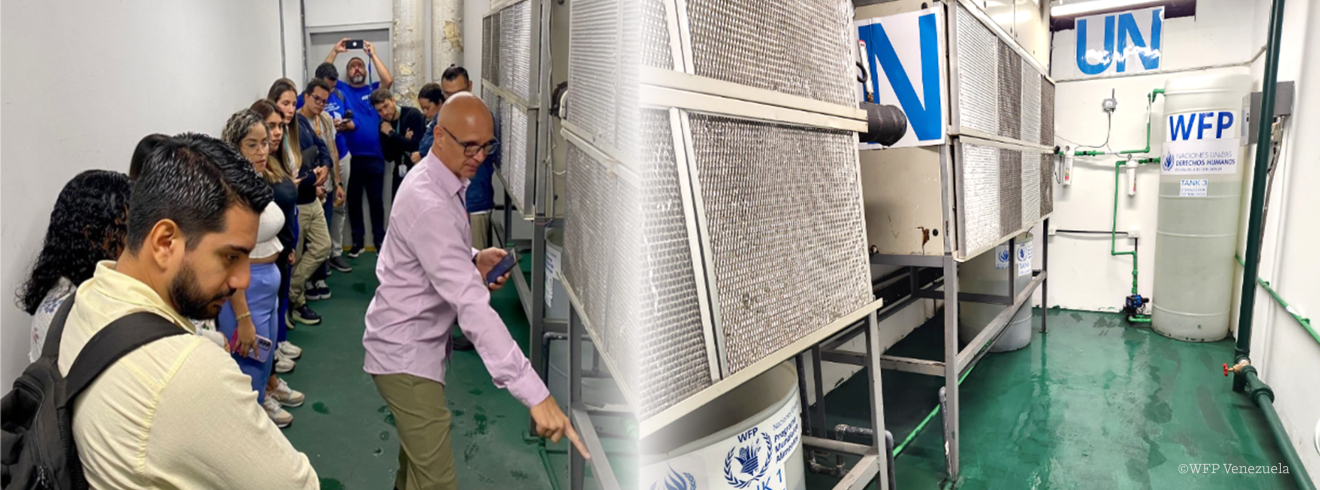
In February 2024, the World Food Programme (WFP) Venezuela Country Office launched an innovative solution to reduce water consumption: a system to harvest water from office air conditioners. So far, the system has recovered 14,000 litres of water, cutting the office’s annual water consumption by >25%.
What started as a small idea has grown into a successful example of interagency collaboration.
A Practical Solution for Visible Challenge
The idea was born in 2023, when WFP personnel noticed large volumes of clean water being discharged by the air conditioning units. Water was simply going to waste.
Recognizing the potential for reuse, WFP proposed a water harvesting system as part of broader sustainability efforts led by WFP Venezuela Country Office and the Office of the High Commissioner for Human Rights (OHCHR).
How it works
The water harvesting system is designed to collect, filter, store and distribute water from AC condensation. It includes:
- Two 350-litre collection tanks
- One 750-litre storage tank
- Filters, supply and distribution pipes
- Pumps for storage and distribution
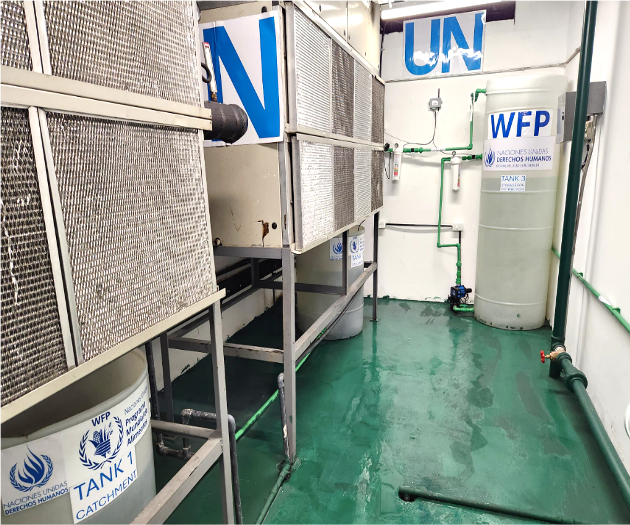
With a total storage capacity of 1,500 litres, the system collects an average of 80 litres of water per day over a 12-hour period of AC operation.
The harvested water is now used daily to clean floors and windows, irrigate plants, cool radiators, and even maintain the AC system itself.

Accurate data collection was a top priority. WFP installed a WIFI data transmission system to track the litres of water used. Data is uploaded to a dashboard, helping monitor performance, set goals and report impact.
Overcoming Challenges through Collaboration
Implementing such a solution required navigating logistical and administrative hurdles, such as obtaining permissions to install equipment in shared building spaces.
Finding local service providers that meet international standards and could support implementation of such solutions was also challenging in Venezuela’s current economic climate.
Collaboration was key to overcoming these barriers.
WFP and OHCHR worked closely together throughout the project, receiving valuable technical advice from UNHCR (United Nations High Commissioner for Refugees) to incorporate solar power to this system. Office personnel played an important role, as they were actively involved in the process and now use the water daily for cleaning and maintenance.
Inspiring Replication and Next Steps
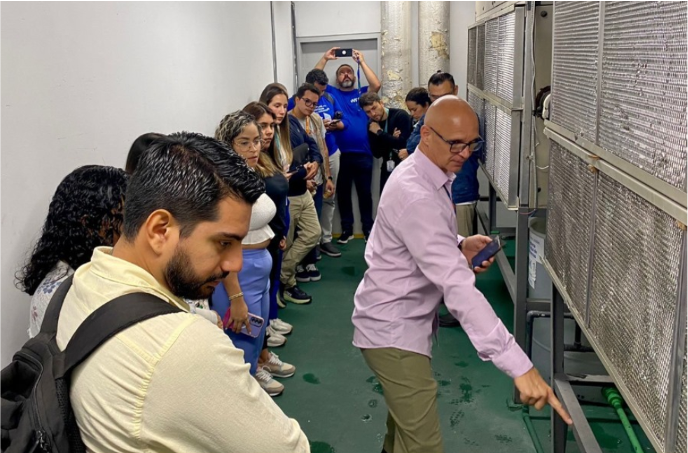
The water harvesting system has been demonstrated to other United Nations agencies as well as humanitarian NGOs to promote good practices in environmental sustainability. The project’s success has already sparked interest from other UN entities. The United Nations Development Programme (UNDP), currently renovating its offices in the same building, plans to implement a similar system using its own AC units.
Building on this success, WFP is exploring ways to expand the system’s use, including potential connections to nearby restrooms for toilet flushing.
The water harvesting initiative at WFP Venezuela is a great example of how small changes can lead to meaningful and long-lasting results. Thanks to close collaboration and creative thinking, the WFP Venezuela team transformed wasted water into one more opportunity for embedding sustainability into its operations.
Learn more:
WFP in Venezuela
WFP Climate Action
This article was written by Angelica Caballero and Ilektra Papadaki (UNEP) based on input and interviews with colleagues from WFP Venezuela and OHCHR.
Quicklinks
Related News

The 2024 Annual Statistical Report on United Nations Procurement (ASR) is now available. The report provides an overview of UN procurement in support of its operations, projects, and programmes. It presents key trends, including a…

In response to growing challenges of climate change and increasing water scarcity, the Economic Commission for Latin America and the Caribbean (ECLAC) has implemented a comprehensive water management plan at its headquarters in Santiago…

Announcement of the winning teams of the 2023 UN Procurement Awards.