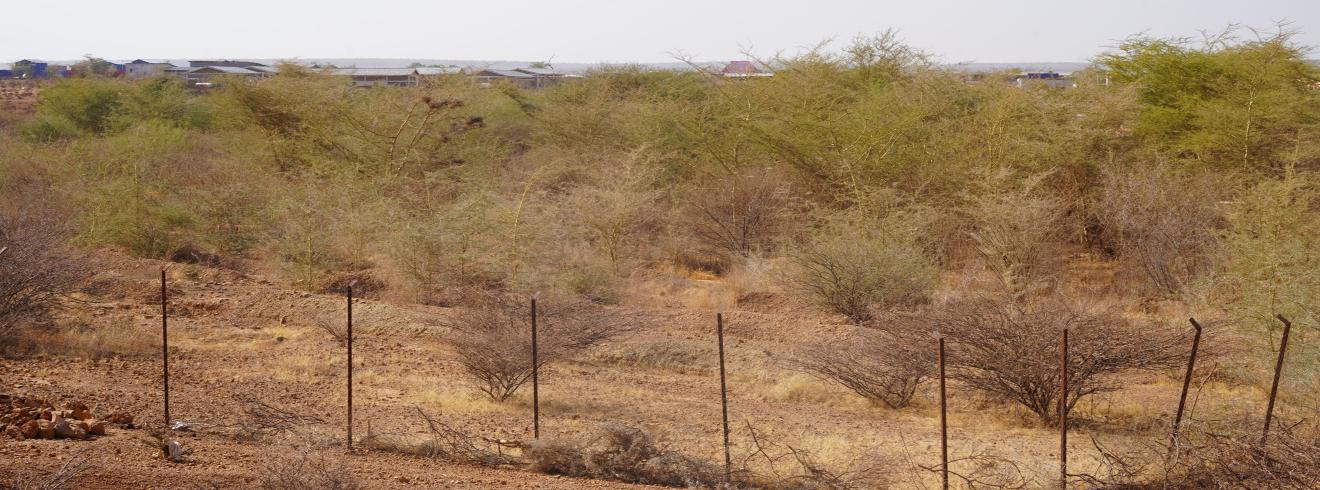
In 2015, UNHCR, together with local authorities, initiated exclosure sites on 12 hectares of degraded land in Melkadida in order to address the environmental impact associated with refugee settlements in the region.
The establishment of such exclosure sites is mainly intended to create buffer zones, where any disturbance of the biological regeneration would be substantially reduced. This would allow biodiversity restoration while conserving the existing ecosystem from further degradation. The process is further enhanced by enrichment planting that takes place annually.
By 2020, a further 177 hectares of degraded land, distributed over nine sites, had been enclosed to restore the dwindling forest cover and improve the preservation of biodiversity. Six of the exclosure sites are also designated as conservation sites.
"There has already been a large amount of regeneration" said Zerihun Tebeje Ayele, Assistant Environment Officer at Melkadida, Ethiopia. "Numerous trees and shrubs are thriving and we are looking forward to seeing further biodiversity across all the sites."
Quicklinks
Related News

On the rooftop of IFAD’s HQ in Rome, two beehives are doing more than making honey — they’re helping monitor urban air quality. By analyzing the honey for pollutants through the University of Tor Vergata in Rome, and comparing it with…
On June 5th, 2024, reflecting on the significance of this day, the Sustainable UN (SUN) facility at UNEP hosted the second Greening the Blue Wednesday Webinar to discuss biodiversity in UN facilities.

12 UN teams in Bangkok took part in the ecosystem restoration quiz contest to celebrate World Environment Day (WED) as a one-UN family on 4 June 2021.