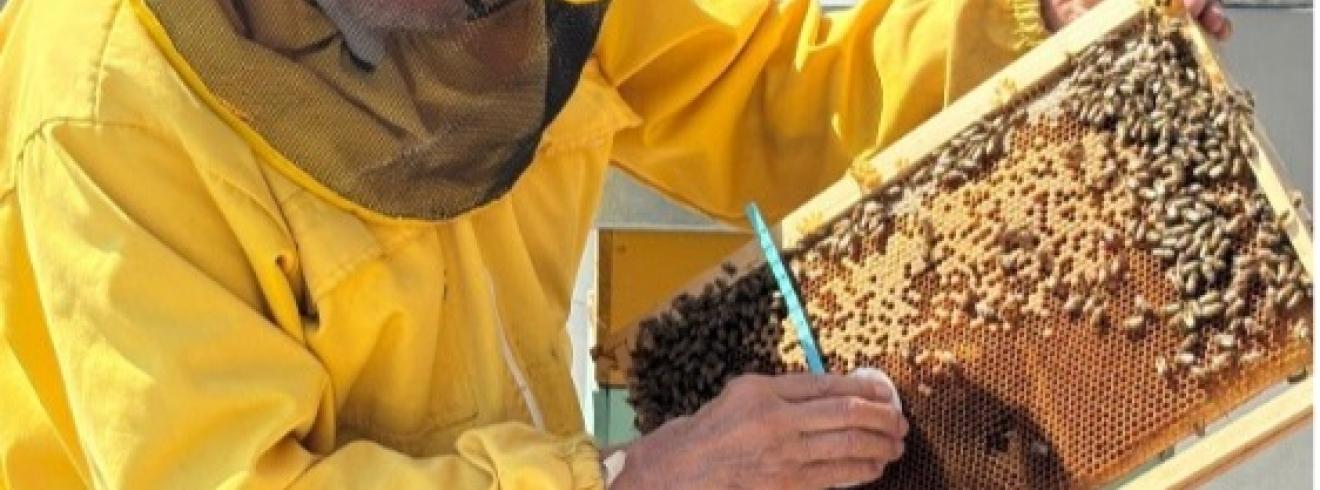
Since 2021, a colony of bees has been quietly helping IFAD monitor the quality of its indoor air — while also producing award-worthy honey. The beehives were installed as part of Bees in the City, an initiative by FAI, the Italian Beekeepers’ Federation, to place hives across Rome and collect extensive city-wide data on pollution and air quality.
Nestled on the rooftop of IFAD Headquarters in Rome, two beehives, maintained by a professional beekeeper, have become a symbol of the organization’s innovative approach to sustainability. Developed in collaboration with the University of Tor Vergata, the project links biodiversity, environmental science, and awareness-raising — with some sweet side effects.
The science behind the sweetness
Bees are not only honey producers but also sensitive environmental indicators. Their bodies and honey absorb trace elements from the surrounding air, making them a natural tool for air-quality monitoring. That’s why IFAD uses the honey harvested from its rooftop apiary as a real-life test of the building’s air filtration performance.
Each year, the hives produce about 100 jars (20–25 kg) of honey. After each harvest, samples are analysed by Tor Vergata University for heavy metals, pesticides, and pollutants such as PM2.5, PM10, and VOCs. Results are compared with readings from IFAD’s meteorological station and recurring indoor air-quality tests, providing a clear comparison between outdoor and filtered air.
Findings show that IFAD’s indoor air consistently meets — and often exceeds — legal standards for offices, with honey analysis confirming significant improvements over the surrounding environment. This is achieved through thorough maintenance, precise monitoring, and high-efficiency air-treatment systems.
A snapshot of urban biodiversity
Bees typically travel up to 5 km from their hive, meaning their honey reflects a mosaic of local ecosystems AD’s honey is a “millefiori” blend, but analysis reveals specific plants the bees visit: eucalyptus, lippia nodiflora, rosemary, steppe sage, lantana, and rose shrubs.
Many of these species grow in IFAD’s pollinator garden, designed at ground level to complement the rooftop hives. Planted in a shaded, north-facing area, the garden features plants that thrive without full sun while supporting pollinators — including hornets, bumblebees, and other insects vital to biodiversity.
Together, garden and hives create a small but impactful ecosystem that supports urban biodiversity and aligns with IFAD’s sustainability goals.
Health checks
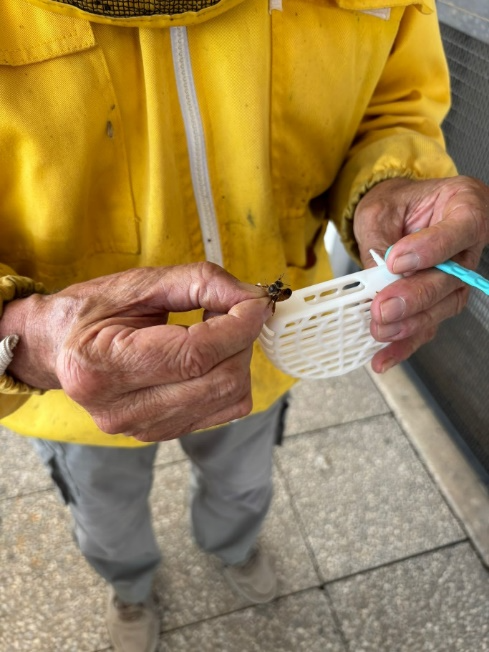
Bee health is essential to the project. Monthly maintenance checks ensure the queen’s presence, colony health, and hive condition. Most recently, IFAD carried out its annual anti-varroa treatment with FAI.
Varroa mites are a major threat to bees worldwide. This year, the queen bee was briefly caged to pause egg-laying, forcing mites onto adult bees where they could be treated with a 100% natural thyme-based solution. This chemical-free method keeps the colony strong and productive. The operation was documented with photos, offering a rare look at bee care in an urban setting.
More than just honey
The honey is not sold commercially — it is shared within the IFAD community and with guests visiting the Headquarters, including delegates, partners, and participants in meetings or events.
It has also featured in dedicated activities such as honey tastings at the IFAD cafeteria and awareness events.
In the past two years, IFAD has marked World Bee Day (20 May) with tastings, costumed colleagues, information booths, and educational materials on the role of pollinators in environmental sustainability.
What began as an experiment is now a living example of applied sustainability — blending research, education, environmental monitoring, and community-building. It’s a model others can replicate, proving that sometimes the smallest workers have the biggest impact.
Want to know more?
Contact Gabriele Mercuri [email protected] and Paola Colangelo [email protected]
Quicklinks
Related News

Personnel-led actions across UNOPS offices drive awareness, collaboration, and behavioral change - all in the context of World Environment Day!

With the onset of COVID-19, the need to remind ourselves about the importance of good green practices has become even more urgent.

The office obtained bikes for staff to use for commutes during work hours, plants to promote mental wellbeing and a greener office atmosphere, and they have partially implemented new environment friendly e-business modalities…