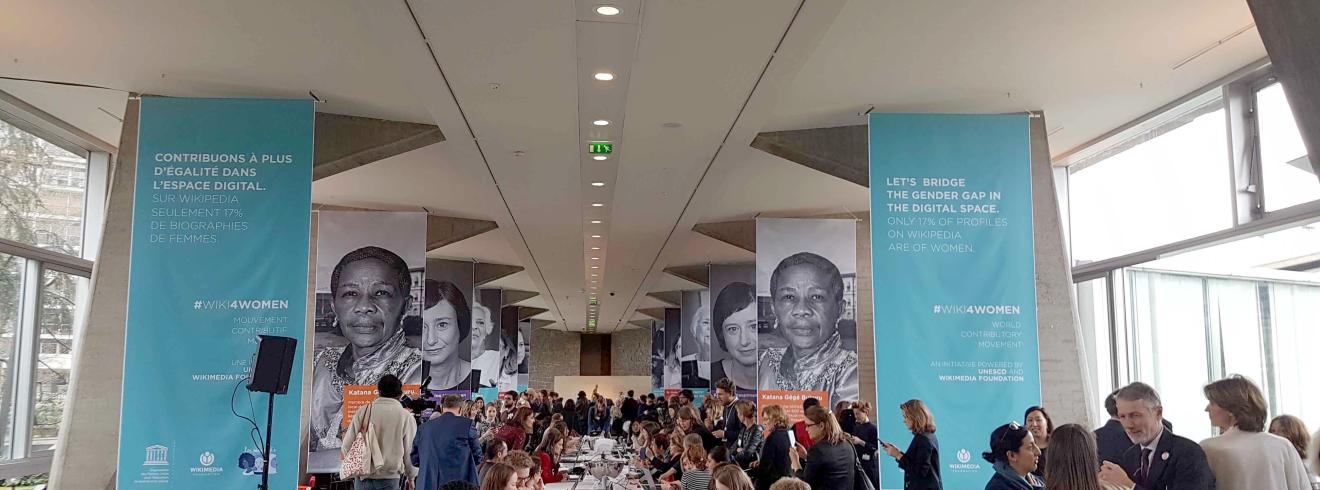
Meetings, Conferences and Cultural Events are an essential dimension of UNESCO’s activities but often come with high environmental costs, including through the use of posters and banners. As an active convener of meetings at its Headquarters in Paris and worldwide, UNESCO holds a particular responsibility to act responsibly in organizing environmental-friendly meetings.
The Organization’s Section for Conferences, Languages and Documents has come up with an innovative upcycling solution: In 2020, it recycled over 400m2 of plastic posters and made them into conference or shopping bags, document folders (A4 and A5 size) and credit card wallets – all hand-made by a company with an ethical recruitment policy and sold at UNESCO’s bookshop in Paris.
To reduce waste of newly produced conference material, UNESCO advises designing banners in a reusable way, e.g., by not specifying the date of a recurring event or by replacing changing partner logos with a sticker. In particular, roll-up banners can be ordered as a reusable version, which has become the default option for any event-specific design and allows for the reuse of the metal base. The poster element of these reusable roll-up banners is printed on either paper (for a single-day use) or a recyclable canvas/tarpaulin. Any permanent roll-up banner no longer needed is carefully disposed of, the waste separated and the remaining base stocked for future use.
To exhibit outside posters on the exterior fences of UNESCO’s Fontenoy building in Paris, vinyl prints are attached to reusable aluminium panels, significantly reducing the waste whenever changing exhibitions. The possibility of permanent frames for the fences is being explored as this would allow to use paper posters with an even smaller environmental footprint.
In line with its Environmental Sustainability and Management Policy, UNESCO has developed internal Guidelines for Green Meetings which include a section on communication and event materials, to ensure that all events across UNESCO are organized as environmental-friendly as possible.
To learn more about UNESCO's environmental work, see
- Staff Guide to a Green UNESCO
- Environmental Sustainability Management at UNESCO
- UNESCO’s commitment to biodiversity
- Education for Sustainable Development
Contact: [email protected]
Quicklinks
Related News

UNICEF’s commitment to environmental sustainability includes a remarkable record of actions to improve the environmental performance of its buildings. With a portfolio of activities across the world, UNICEF inspires positive change in…
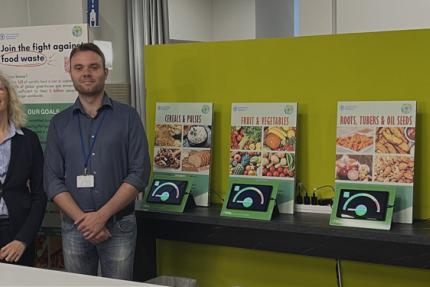
FAO is pioneering a food waste monitoring system at its headquarters, using smart stations to categorize and weigh leftovers in its cafeterias. This initiative helps better understand and reduce food waste, thereby lowering…

Solid Waste Management in Nairobi, Kenya for World Habitat Day On the UN compound in Nairobi one employee generates more than 200 kilograms of waste every year.